When a family first hears that a liver transplant may be needed, there is already a lot to process. Then come the questions: Can someone in the family donate? How long will we have to wait? Is a living donor better? What happens if we don’t have one?
These are not just medical questions. They can affect the entire family. In the living donor vs deceased donor transplant discussion, both options provide a pathway to transplantation, but the journey to each is different. One involves a healthy person donating part of their liver, while the other depends on a suitable liver becoming available through the deceased-donor system.
Understanding these differences can help families replace uncertainty with clarity and have a more informed conversation with their transplant team.
Living Donor vs Deceased Donor Transplant: The Quick Answer
A living-donor liver transplant uses part of the liver donated by a medically suitable living person. A deceased-donor liver transplant uses a liver donated after a person’s death.
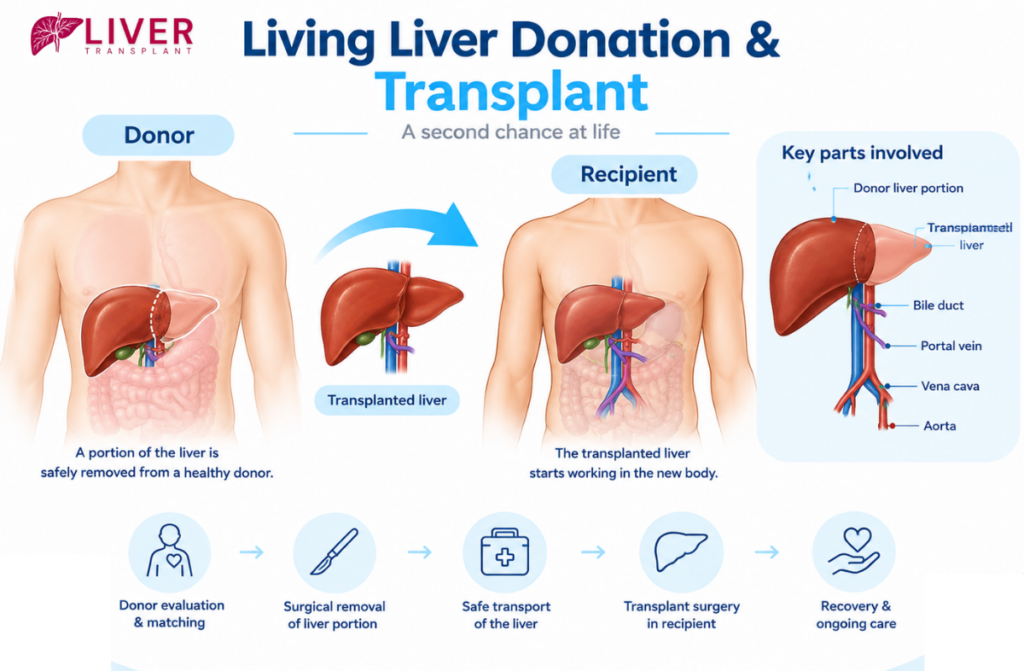
The main differences involve where the liver comes from, how transplantation is timed, organ availability and the considerations involved in donor safety.
| Specification | Living-Donor Liver Transplant | Deceased-Donor Liver Transplant |
| Liver source | A living person donates part of their liver | Liver comes from a deceased donor |
| Waiting | May allow transplantation to be planned if a suitable donor is approved | Depends on organ availability and allocation |
| Timing | Can potentially be scheduled | Depends on when an appropriate organ becomes available |
| Living donor surgery | Required | Not applicable |
| Donor evaluation | Extensive medical and psychosocial assessment | Donor organ is assessed for suitability |
| Key consideration | Safety of the donor and suitability for the recipient | Organ availability and suitability for the recipient |
There is no universally “better” donor type. The appropriate pathway depends on the recipient’s condition, urgency, transplant eligibility, organ suitability and, for living donation, whether the donor can undergo surgery safely.
First, What Actually Changes Between the Two?
The fundamental difference is where the liver comes from.
With a living donor
A healthy person undergoes a detailed evaluation to determine whether they can safely donate a portion of their liver. The donated portion is transplanted into the recipient, while the donor keeps the remaining liver. The liver has a substantial capacity to regenerate, allowing the remaining liver in the donor and the transplanted portion in the recipient to grow and adapt after surgery.
But being willing to donate does not automatically make someone a suitable donor. Their health, liver anatomy, liver volume and other factors must be carefully assessed.
With a deceased donor
The liver comes from a person who has died and whose organs are considered suitable for donation. An eligible recipient remains within the deceased-donor transplant pathway while waiting for an appropriate organ. When a liver becomes available, the transplant team determines whether it is suitable for that particular patient.
Doctor’s Insight: Living donation is different in one important way: the transplant team is caring for two people with very different needs a recipient who needs a transplant and a healthy donor who is choosing to undergo major surgery.
Why Living Donation Can Change the Timing
For many families, this is the question behind the question:
“Could we avoid a long wait?”
If a medically suitable living donor is identified, evaluated and approved, transplantation may be planned rather than depending entirely on when a deceased-donor liver becomes available.
This can offer some practical advantages:
- More predictable timing: Once donor and recipient evaluation is complete and transplantation is approved, surgery can potentially be scheduled.
- Less dependence on deceased-organ availability: The recipient may not need to wait for an appropriate deceased-donor liver to become available.
- Potentially earlier transplantation in selected patients: Avoiding prolonged waiting can be valuable when the patient’s medical condition makes timing particularly important.
- Time for preparation: Both donor and recipient can complete the necessary assessments before surgery.
However, living donation is not simply a faster version of transplantation.
The donor must still be medically suitable, the donated portion must be appropriate for the recipient, and the transplant team must determine that proceeding is in the best interests of both individuals.
What if There is No Suitable Living Donor?
Not having a living donor does not mean that transplantation is no longer possible. Deceased-donor transplantation remains an essential pathway for eligible patients. The recipient can be evaluated for transplantation and, when appropriate, enter the deceased-donor allocation pathway.
The waiting period cannot be predicted for everyone. It may be influenced by medical urgency, organ availability, compatibility and applicable allocation policies, among other factors. For families, waiting can be one of the hardest parts of the transplant journey because there is no simple answer to “How long will it take?”
But waiting does not mean the patient is simply left without care. The transplant team continues to assess the patient’s condition and manage their health while they remain in the transplant pathway.
The Person Donating Needs Just as Much Care and Protection
When someone says, “I’ll donate part of my liver,” it can feel like the solution has already been found.
Medically, that is only the beginning. A living donor may be a healthy person who does not need an operation for themselves, yet chooses to undergo major surgery to help someone else. Their safety therefore has to be considered independently of the recipient’s needs.
Evaluation may include:
- Blood and laboratory tests to assess overall health.
- Imaging studies to examine the liver, blood vessels and anatomy.
- Assessment of liver volume to determine whether enough liver will remain for the donor and whether the donated portion is appropriate for the recipient.
- Medical assessment to identify factors that could increase surgical risk.
- Psychological and social evaluation to support an informed and voluntary decision.
- Detailed counselling about the procedure, potential risks and recovery.
A potential donor may be declined if donation is considered unsafe.
Doctor’s Insight: A family’s willingness to donate is deeply meaningful, but it cannot be the deciding factor. The donor must be protected throughout the process, even when everyone is focused on helping the recipient.
Living Donor vs Deceased Donor: How the Journey Compares
| Stage | Living Donor | Deceased Donor |
| Starting point | Potential donor is identified | Recipient enters the deceased-donor pathway if eligible |
| Evaluation | Donor and recipient undergo detailed assessment | Recipient is evaluated; available organs are assessed for suitability |
| Timing | Can potentially be planned after approval | Depends on when a suitable organ becomes available |
| Donor surgery | Donor undergoes major surgery | No living donor undergoes surgery |
| Recipient surgery | Liver portion is transplanted into recipient | Donated liver is transplanted into recipient |
| Waiting | May reduce dependence on deceased-organ availability | Waiting depends on allocation and organ availability |
| Recovery | Both donor and recipient have recovery periods | Recipient undergoes transplant recovery |
The difference is not that one journey is easy and the other difficult.
They involve different kinds of preparation, timing and uncertainty.
Is Living Donor Transplant Always Better?
No.
It is easy to make the assumption:
Living donor → less waiting → therefore better.
But transplantation is more complex than that. A potential donor may not be suitable because of their overall health, liver anatomy, liver volume or other medical considerations. The recipient’s condition also determines whether living-donor transplantation is appropriate.
A deceased-donor liver must similarly be evaluated for its suitability for the recipient. So the decision should not be based on which donor type sounds preferable in general.
It should be based on:
Recipient health + urgency + transplant eligibility + donor suitability + organ suitability + surgical considerations
And when living donation is considered, there is one additional responsibility:
protecting the healthy donor.
Myth vs Fact: What Families Often Assume
| Myth | Fact |
| A living donor gives away their entire liver. | Only a portion of the liver is donated. |
| Anyone who volunteers can become a donor. | Potential donors undergo extensive evaluation and may be declined if donation is unsafe. |
| Living donation is always the better option. | The appropriate pathway depends on the individual recipient and donor circumstances. |
| A deceased-donor transplant is a second-best option. | Deceased donation is an established and essential pathway for eligible patients. |
| A close relative is automatically a suitable donor. | Being related does not by itself determine medical suitability. |
| The donor’s needs come after the recipient’s needs. | Donor safety is a fundamental part of living-donor transplantation. |
Which Option May Be Appropriate for Your Situation?
There is no single answer that applies to every patient.
The transplant team considers the whole clinical picture, rather than making the decision based on donor type alone.
For a potential living donor, the team considers:
- Whether the person is healthy and medically suitable to donate.
- Whether the liver anatomy and volume are appropriate.
- Whether donation can be performed with an acceptable level of risk.
- Whether the donated portion is suitable for the recipient.
- Whether transplantation is appropriate for the recipient at that time.
For deceased donation, the team considers:
- Whether the patient is eligible for transplantation.
- Medical urgency and allocation considerations.
- Whether an appropriate organ becomes available.
- Whether the available liver is suitable for the recipient.
- Whether transplantation remains the appropriate treatment at that point.
This is why families should not feel pressured to decide between the two based on general information alone.
The right option is the one that makes medical sense for that particular patient and, when applicable, protects the donor as well.
The Questions That Can Make Your Transplant Consultation More Useful
When there is a lot to absorb, knowing what to ask can make the conversation easier.
Consider discussing:
- Is living-donor transplantation appropriate for my condition?
- Would waiting for a deceased donor affect my treatment plan?
- What would make a potential donor medically suitable?
- What are the risks and expected recovery for the donor?
- How could living donation affect the timing of transplantation?
- What factors influence the deceased-donor waiting process?
- What should the recipient and donor expect before and after surgery?
You do not need to arrive at the consultation with every decision already made. The purpose of the transplant evaluation is to help you understand what is possible, what is appropriate and what is safest.
Why it Helps to Discuss Transplant Options Early
A transplant discussion does not necessarily mean that surgery has to happen immediately. When liver disease is advanced or progressing and transplantation may eventually be needed, early evaluation gives the patient and family more time to understand their options.
It can help the transplant team assess eligibility, discuss the deceased-donor pathway and determine whether living donation could be considered. It also gives a potential donor time to understand the evaluation process and what donation would involve.
Doctor’s Insight: Early transplant evaluation is not about rushing someone into surgery. It is about making sure important options are understood before the patient’s condition or time pressure makes the decision more difficult.
A Decision You Don’t Have to Make Alone
For a family facing liver transplantation, hearing the words “living donor” and “deceased donor” can make the situation feel even more complicated.
But these are not two choices that a family has to rank on its own. A living donor may make planned transplantation possible when a suitable donor is available, but it also means major surgery for a healthy person whose safety must be carefully protected.
A deceased-donor transplant does not require a living person to undergo donor surgery, but its timing depends on organ availability and the applicable allocation process.
“Which transplant pathway is safest and most appropriate for this patient?”
That answer comes from understanding the patient’s medical condition, evaluating the available options and discussing them with an experienced transplant team.
You do not need to have all the answers before starting that conversation. The first step is simply understanding what options may be available and knowing that the decision can be made carefully, with the patient’s health and the donor’s safety at the centre of it.
Read More: Preparing for Liver Transplant Surgery