Living Donor Liver Transplant

Living donor liver transplant exists because of that reality. It is one of medicine’s most extraordinary acts — a healthy person voluntarily undergoing major surgery to give a portion of their own liver to someone who would otherwise die. It is made possible by one of the liver’s most remarkable biological properties: its ability to regenerate. A donated liver segment grows back to near-normal size in both the donor and the recipient within weeks. Two people. One liver. Both whole again.

The concept is simultaneously simple and profound. And it represents, for many patients and families, the difference between a transplant that happens in time and one that comes too late.

This guide covers everything you need to know about living liver donation what it involves, who can donate, how the evaluation works, what the surgery looks like, what the risks are, and what the evidence says about outcomes for both donors and recipients. Whether you are considering donating, have been told you need a liver transplant, or are simply trying to understand this remarkable medical procedure, this is your comprehensive starting point.

What is Living Liver Donation?

Living liver donation is a surgical procedure in which a healthy, living person donates a portion of their liver to someone with end-stage liver disease or liver failure who needs a transplant to survive.

It is distinct from deceased donor transplantation where a liver comes from a brain-dead donor whose family has consented to organ donation in that the donor is alive, fully conscious, and making a voluntary, informed decision to undergo major surgery for the benefit of someone else.

The biological basis for living liver donation is the liver's unique regenerative capacity. No other solid organ in the human body can do what the liver does after partial removal regrow. Within six to eight weeks of surgery, the donor's remaining liver segment regenerates to approximately 85 to 95 percent of the original liver volume. Simultaneously, the transplanted segment in the recipient grows to reach the volume required to support the recipient's body weight and metabolic needs. Both donor and recipient end up with functional livers of appropriate size a biological phenomenon that makes this procedure possible in a way that would simply not work for any other organ.

Living liver donation accounts for a significant proportion of all liver transplants performed globally — and in some countries, particularly Japan, South Korea, India, and other parts of Asia where deceased donor transplantation is limited by cultural, legal, or logistical factors, living donor transplantation is the dominant form of liver transplantation.

Why is Living Donor Liver Transplant Done?

The fundamental reason living donor liver transplant exists is to save lives that would otherwise be lost — either because a deceased donor organ is not available in time, or because living donor transplantation offers specific clinical advantages that make it the preferred option even when deceased donor organs are available.

Shortage of deceased donor organs is the primary driver. In most countries, the number of patients on liver transplant waiting lists far exceeds the supply of deceased donor livers. Patients wait months to years. During that wait, their liver disease progresses. Their MELD score rises. Complications develop — ascites, encephalopathy, variceal bleeding, kidney failure. Some patients become too unwell to safely undergo transplantation by the time an organ becomes available. Some die waiting. Living liver donation directly addresses this gap by creating an additional source of organs that is independent of the deceased donor supply.

Timing and elective scheduling is a significant advantage of living donation. A deceased donor transplant is always an emergency — a phone call at any hour, a rush to the hospital, surgery performed on a timeline dictated by organ availability. A living donor transplant is planned. The recipient can be optimised medically in the weeks before surgery. The surgical team can be fully rested and prepared. The organ is retrieved and implanted in the same operating theatre complex, minimising cold ischaemia time — the period between organ removal and reimplantation — which is one of the most important determinants of transplant organ quality and early function.

Superior organ quality is directly related to that reduced cold ischaemia time. A living donor liver is warm, healthy, and transplanted within minutes to hours of retrieval. A deceased donor organ may spend hours in cold preservation before reaching the recipient. The difference in early graft function is measurable and clinically significant.

Paediatric recipients benefit particularly from living donation because child-sized deceased donor livers are extremely scarce. A left lateral segment from an adult donor — typically comprising 20 to 25 percent of the total liver volume — is exactly the right size for a small child. Without living donation, many children with biliary atresia and other paediatric liver diseases would have no realistic transplant option.

Hepatocellular carcinoma patients sometimes face specific circumstances where timely transplantation is critical — if the tumour grows beyond transplant criteria while the patient waits for a deceased donor organ, they may become ineligible. A planned living donor transplant can be scheduled before that threshold is crossed.

Who is a Suitable Living Liver Donor?

Not everyone who wants to donate can donate. The evaluation process for living liver donors is deliberately thorough and conservative because the donor is a healthy person who gains no direct medical benefit from surgery, the standard of justification required is significantly higher than it would be for a patient undergoing surgery to treat their own disease.

Age is one of the first considerations. Most transplant centres accept donors between the ages of 18 and 55 to 60, though upper age limits vary between programmes. Older donors can be accepted in selected cases where their overall health and liver quality are excellent, but the risk of surgical complications increases with age.

Blood group compatibility is assessed early. The donor's blood group must be compatible with the recipient's — either identical or compatible according to ABO blood group rules. Some centres perform ABO-incompatible living donor transplants with special protocols, but this remains the exception rather than the standard.

Body weight and BMI are considered because excess body fat particularly fat within the liver itself (hepatic steatosis) affects the quality of the donated liver segment and the safety of surgery for the donor. Most programmes require a BMI below 30 to 35 and minimal hepatic steatosis on imaging.

Overall physical health must be excellent. Donors must have no significant medical conditions — no diabetes, no hypertension requiring medication, no prior liver disease, no clotting disorders, no serious cardiac or pulmonary disease. A thorough medical assessment ensures the donor can safely tolerate major surgery and the subsequent recovery period.

Liver anatomy must be favourable. The liver's internal blood vessel and bile duct anatomy varies considerably between individuals. Some anatomical configurations make safe division of the liver impossible without placing the donor at unacceptable risk. Detailed imaging is required to assess whether the donor's anatomy is suitable for living donation.

Liver volume calculations are critical. The transplant team calculates the graft-to-recipient weight ratio — the volume of the donated liver segment relative to the recipient's body weight. Too small a segment risks small-for-size syndrome in the recipient, where the graft is insufficient to meet metabolic demands. Too large a removal risks leaving the donor with insufficient liver volume for their own recovery. Most programmes aim for a remnant liver volume of at least 30 to 35 percent of the donor's total liver volume.

Psychological suitability is evaluated carefully. The donor must be acting entirely voluntarily — free from coercion, financial pressure, or inappropriate emotional pressure from family. They must have a realistic understanding of what the surgery involves, what the recovery entails, and what risks they are accepting. A history of significant mental health conditions, active substance misuse, or evidence of external pressure may disqualify a potential donor.

Relationship to the recipient varies by programme and country. Most centres prefer emotionally related donors — close family members or partners with a genuine long-standing relationship. Some accept altruistic unrelated donors with careful additional psychological scrutiny. Financial compensation for donation is prohibited in virtually all jurisdictions and is considered a form of organ trafficking.

How Does Living Liver Donation Work?

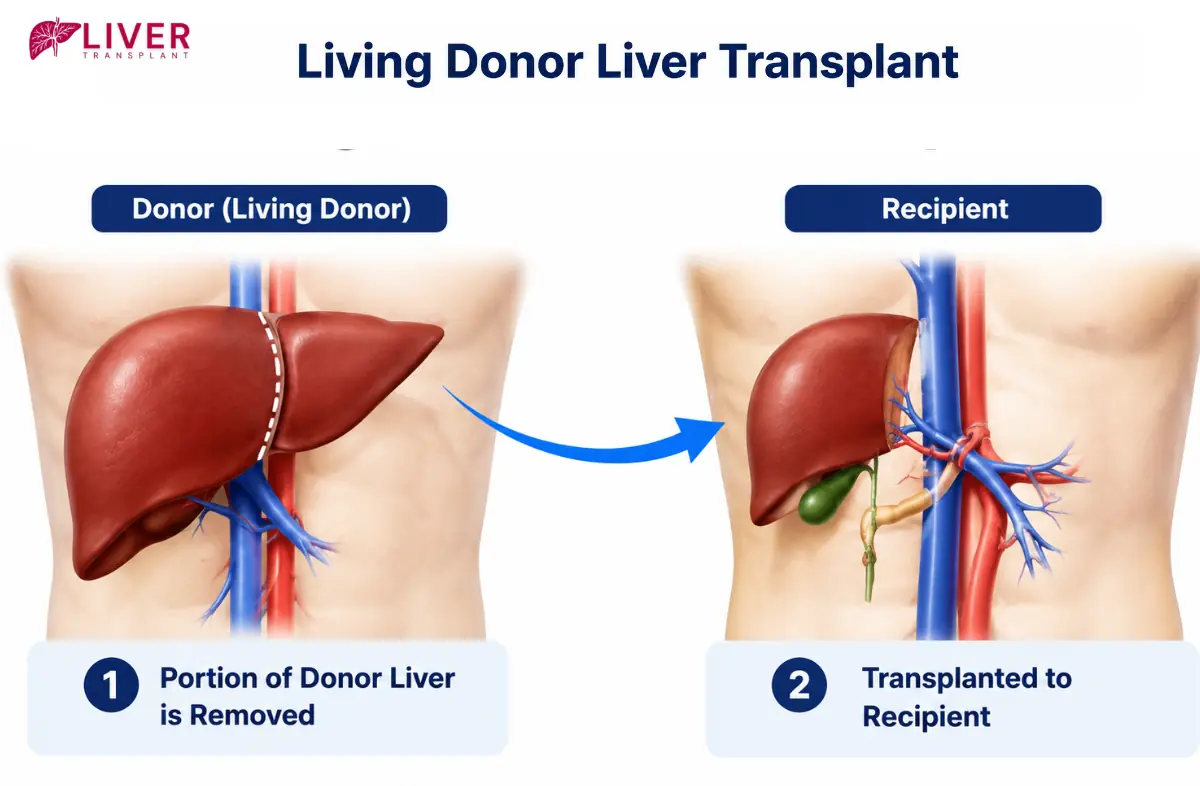
Living liver donation involves two simultaneous surgical operations the donor surgery, in which a portion of the liver is removed, and the recipient surgery, in which the diseased liver is removed and replaced with the donated segment. Both operations typically take place in adjacent or nearby operating theatres on the same day, with coordinated surgical teams.

The portion of the liver that is donated depends on the size of the recipient. For adult-to-adult donation, the right lobe comprising approximately 60 to 70 percent of the total liver volume is most commonly used, as this provides sufficient liver mass for an adult recipient. For adult-to-child donation, the left lateral segment the smaller left portion of the liver is used, as its volume is appropriate for a child recipient.

The donor operation begins with the patient under general anaesthesia. The surgeon carefully dissects the liver along the appropriate anatomical plane, dividing the liver tissue while individually sealing or ligating the blood vessels and bile ducts that cross the division line. This requires meticulous surgical technique and often takes four to six hours. The dissected segment is then carefully removed and immediately prepared for transplantation flushed with cold preservation solution and assessed for quality before being brought to the recipient's operating theatre.

The recipient operation involves first removing the diseased liver a process called hepatectomy that is often the most technically complex part, particularly if the recipient has portal hypertension, extensive scarring, or prior abdominal surgery. The donor segment is then implanted blood vessels and bile ducts are reconnected one by one, and once the clamps are released and blood flows through the new liver, the surgical team assesses for function, bleeding, and bile production.

Both operations carry risk and both surgical teams maintain their full focus and commitment throughout the procedure. The donor's welfare is not compromised in any way for the sake of expediting the recipient operation.

Evaluation Process

The evaluation of a potential living liver donor is one of the most comprehensive medical assessments a healthy person will ever undergo. It is designed to answer one central question: can this person donate safely, and can they do so without unacceptable long-term consequences to their own health?

The evaluation typically takes place over several weeks and involves multiple clinic visits, numerous tests, and meetings with different members of the transplant team including surgeons, hepatologists, anaesthetists, psychologists, transplant coordinators, and independent donor advocates.

It begins with an initial screening blood group testing, basic medical history, and a preliminary assessment of eligibility before proceeding to detailed investigations for those who pass the initial screen. Only a minority of people who express interest in living liver donation ultimately proceed to surgery because the evaluation is designed to identify and exclude anyone for whom donation would carry unacceptable risk.

The process is entirely voluntary at every stage. Potential donors can withdraw at any point without any obligation to explain their decision to the recipient or the recipient's family.

How is the Liver Donor Assessed?

The detailed donor assessment covers every aspect of physical and psychological health relevant to the safety of donation and the suitability of the donated liver.

Blood tests form the foundation of the medical assessment. A complete blood count assesses general health and screens for blood disorders. Liver function tests ALT, AST, ALP, GGT, bilirubin, albumin, and INR — must all be entirely normal, confirming that the donor's liver is healthy. Kidney function tests ensure adequate renal reserve. Coagulation studies screen for clotting disorders that would increase surgical bleeding risk. Viral serology including hepatitis B, hepatitis C, HIV, and cytomegalovirus is tested both to protect the recipient from transmitted infection and to assess the donor's own health status. Blood type is confirmed definitively. Metabolic tests including fasting glucose and HbA1c screen for diabetes, and a full lipid profile is obtained.

Liver imaging is the most important single component of the anatomical assessment. MRI of the liver with specific volumetric sequences is performed to calculate the exact volume of each liver lobe and segment confirming that the planned donation will leave the donor with sufficient liver volume. MR cholangiopancreatography (MRCP) maps the biliary anatomy in detail, identifying variations that might make safe bile duct division impossible or significantly increase bile leak risk. CT angiography or MR angiography maps the hepatic artery and portal vein anatomy variations in vascular anatomy are common and must be understood before surgery to allow safe planning of vessel division and reconstruction.

Liver biopsy is performed in some donors when imaging suggests possible hepatic steatosis (fatty liver) or when liver enzyme levels are borderline. A fat content above 10 to 15 percent on biopsy is generally considered a contraindication to donation because fatty livers regenerate less effectively and have higher complication rates after partial resection.

Cardiac assessment includes an ECG and, for donors above a certain age or with any cardiac risk factors, an echocardiogram and exercise stress test. The donor must be able to safely tolerate major abdominal surgery and general anaesthesia.

Pulmonary function testing is performed to ensure adequate respiratory reserve, as postoperative breathing difficulties are a recognised complication of upper abdominal surgery.

Psychological evaluation is conducted by a transplant psychologist or psychiatrist independent of the surgical team. It explores the donor's motivations confirming voluntariness and absence of coercion. It assesses emotional resilience, coping strategies, and the donor's realistic understanding of what the surgery, recovery, and potential complications involve. It evaluates the quality of the relationship between donor and recipient and ensures that the donor has a realistic expectation of how donation may affect that relationship — both positively and potentially negatively if outcomes are not as hoped.

Independent Donor Advocate (IDA) — a professional who represents the donor's interests exclusively, independent of the recipient's care team is involved in many programmes. The IDA ensures that the donor's wellbeing is always the primary consideration and that no pressure explicit or implicit is influencing the donation decision.

Financial and social assessment explores the donor's support structure for the recovery period whether they have adequate cover for time off work, childcare, and domestic responsibilities and in some countries, coordinates financial support to cover expenses related to donation.

What are the Benefits of Live Donor Liver Transplant?

The benefits of living liver donation flow primarily to the recipient but they extend in meaningful ways to the donor and to the broader transplant system.

For the recipient, the most fundamental benefit is survival. For patients who might otherwise die waiting for a deceased donor organ, a living donor transplant is the difference between life and death. Beyond survival, the planned nature of living donor transplantation means recipients can be in the best possible condition at the time of surgery nutritionally optimised, with complications managed, and electively prepared. The superior organ quality from reduced cold ischaemia time translates into better early graft function, lower rates of primary non-function, and in many series, better long-term graft and patient survival compared to deceased donor transplantation.

For paediatric recipients, living donation is often the only realistic option. The scarcity of appropriately sized deceased donor livers for children means that without a living donor, many children — particularly those with biliary atresia — would not survive to reach a transplant.

For recipients with hepatocellular carcinoma, a planned living donor transplant allows surgery to be timed strategically — before tumour progression takes the patient outside transplant criteria — potentially converting a patient from ineligible to eligible and saving their life.

For the donor, benefits are non-medical but deeply meaningful. Surveys of living liver donors consistently show high rates of satisfaction, a strong sense of purpose, and positive psychological impact — the knowledge that a voluntary, generous act has directly saved another person's life. Most donors report that they would make the same decision again.

For the transplant system, every living donor transplant creates capacity — one fewer patient competing for scarce deceased donor organs, freeing those organs for patients who do not have living donor options.

Risks and Complications of Living Donor Liver Transplant

Honesty about risk is fundamental to ethical living donation. A healthy person is being asked to accept surgical risk for the benefit of someone else and that requires complete, transparent, and accurate information about what that risk entails.

Donor mortality is the most serious risk and it is real, not theoretical. The reported mortality rate for living liver donors in large published series is approximately 0.1 to 0.5 percent for left lobe donation and 0.3 to 0.5 percent for right lobe donation. These numbers are small but not zero. A healthy person undergoing this surgery accepts a small but genuine risk of death and every potential donor must understand and accept this before proceeding.

Bile leak is the most common serious surgical complication, occurring in approximately 5 to 15 percent of donors depending on the surgical technique and anatomy. Bile leaks from the cut surface of the liver or from the divided bile duct margin and can cause abdominal infection, require additional procedures or reoperation, and significantly extend hospital stay and recovery time.

Biliary stricture — narrowing of the remaining bile duct can develop in the months after surgery and may cause symptoms of bile obstruction including jaundice, itching, and recurrent cholangitis. It may require endoscopic treatment (ERCP with balloon dilation) or, in severe cases, surgical revision.

Bleeding during or after surgery may require blood transfusion or return to the operating theatre. The liver is a highly vascular organ and major haemorrhage, while uncommon, is a recognised risk of any hepatic surgery.

Wound complications including infection, hernia, and wound breakdown are relatively common minor complications, as with any major abdominal surgery.

Pulmonary complications — pneumonia, pleural effusion, and atelectasis — occur in a proportion of donors, particularly those who smoke, have borderline pulmonary function, or experience a complicated postoperative course.

Small-for-size syndrome in the recipient occurs when the donated segment is insufficient in volume to meet the recipient's metabolic needs, causing early graft dysfunction. Careful volumetric calculations during donor assessment aim to prevent this, but it remains a risk — particularly in adult-to-adult right lobe donation where the balance between donor safety (leaving enough liver behind) and recipient adequacy (giving enough liver) is most finely calibrated.

Psychological complications in donors — while less common than physical ones — are important. A proportion of donors experience depression, anxiety, or adjustment difficulties in the recovery period, particularly if their physical recovery is slow or complicated, or if the recipient's outcome is poor despite the donation. Pre-donation psychological support and post-donation follow-up are important components of donor care.

Long-term liver function in living donors is generally excellent. Large long-term follow-up studies show that liver function in donors returns to normal and that long-term mortality and morbidity are not significantly higher than in matched non-donor populations. The liver's regenerative capacity is as remarkable in practice as it sounds in theory.

Time off work and financial impact — while not medical risks — are real practical consequences of donation that must be planned for. Most donors require four to eight weeks off work. Physical recovery to full activity takes three to six months in most cases. Financial assistance programmes, where available, help mitigate the economic impact.

Conclusion

Living liver donation is one of medicine's most extraordinary intersections of human generosity and surgical capability. It asks something remarkable of the donor a voluntary acceptance of surgical risk, a period of physical recovery, and an act of profound altruism and it delivers something equally remarkable to the recipient: a second chance at life.

The decision to donate a portion of one's liver to another person should never be taken lightly and the medical system surrounding living donation exists precisely to ensure that it is not. The evaluation process is thorough because the stakes are high. The risks are disclosed completely because informed consent is not optional it is the ethical foundation of everything. The independent advocate exists because the donor's interests must always be protected independently of the recipient's needs.

For the right donor healthy, well-informed, genuinely voluntary, anatomically suitable, and psychologically prepared living liver donation is safe in the vast majority of cases, recovers fully, and delivers outcomes that transform lives. Thousands of people alive today adults and children owe their continued existence to a living donor who made that choice.

If you are considering living liver donation either for a family member or as an altruistic donor the first step is a conversation with a transplant centre that can give you personalised, accurate information based on your specific situation. No information in this guide replaces that conversation. But it gives you the foundation to walk into it informed, prepared, and with the right questions already in mind.

Frequently Asked Questions

Yes. Most living liver donors go on to live normal, healthy lives after recovery. The liver has a unique ability to regenerate, and the remaining portion usually grows back to near-normal size within months. Donors can typically return to work, exercise, and daily activities after recovery. Regular follow-up care is important to monitor healing and overall health.

Living donor liver transplantation has excellent outcomes at experienced transplant centers. Recipient survival rates are typically above 85–90% at one year and remain high over the long term. Donor safety is also very good, with most donors recovering fully. Success depends on factors such as the recipient’s condition, surgical expertise, post-transplant care, and adherence to medical recommendations.

Recovery time varies between individuals, but most liver donors stay in the hospital for about 5–7 days after surgery. Many can resume light daily activities within a few weeks and return to work in 6–12 weeks, depending on the type of job. Full recovery may take several months. Regular follow-up appointments help ensure proper healing and liver regeneration.

No data was found
Living donor liver transplantation offers faster treatment, improved recovery, and better long-term liver health for patients.

Conditions Treated

Comprehensive medical care for a wide range of conditions, focused on recovery, symptom management, and long-term wellness.

Read Next

Discover lifelong strategies, medications, monitoring, and healthy habits to maintain
Learn recovery steps, medications, nutrition, follow up care, and lifestyle
Get ready for liver transplant surgery with practical steps, nutrition,
Learn the differences, benefits, risks, and outcomes of living and
Explore liver transplant eligibility, evaluation criteria, and essential guidance to
Fatty liver disease develops due to excess fat buildup in