
Being told that Liver Transplant Treatment may be necessary can be difficult to process. After years of managing liver disease, hearing the word transplant can make the future suddenly feel uncertain.
The good news is that transplantation is rarely a decision made overnight. It is usually a carefully assessed treatment pathway, based on how much the liver has been affected, whether complications are developing, and whether replacing the liver is likely to offer a meaningful benefit.
This guide explains that journey in simple terms — from understanding when liver transplant treatment is considered, to evaluation, donor options, surgery, recovery, and life afterward.
What is a Liver Transplant?
A liver transplant is an operation in which a severely damaged or failing liver is replaced with a healthy donor liver or, in suitable cases, a portion of a donor liver.
The liver performs essential functions, including processing nutrients and medicines, producing important proteins and helping remove harmful substances from the body. When advanced disease prevents it from performing these functions adequately, transplantation may become the most appropriate long-term treatment.
There are two main ways a donor liver can be obtained:
- Deceased donor transplant: A suitable liver is donated after a person has died and is allocated according to the applicable organ donation and matching system.
- Living donor transplant: A healthy person donates a portion of their liver. The liver’s ability to regenerate allows the remaining liver in the donor and the transplanted portion in the recipient to grow and adapt after surgery.
One point is particularly important for families: being referred for a transplant evaluation does not mean that surgery is going to happen immediately. The evaluation determines whether transplantation is appropriate, how urgently it may be needed and which treatment pathway is safest.
When Does a Liver Transplant Become Necessary?
Not everyone with liver disease needs a transplant. Many people can live with chronic liver disease for years with appropriate treatment, monitoring and control of the underlying cause.
Transplantation generally enters the discussion when liver damage becomes severe and irreversible, particularly when the liver begins to struggle to support the body’s needs.
Doctors may consider transplantation when complications such as these develop:
- Ascites: Fluid repeatedly collects in the abdomen and becomes difficult to control despite treatment.
- Hepatic encephalopathy: Toxins that the damaged liver can no longer process effectively affect brain function, causing confusion, changes in behaviour or reduced alertness.
- Variceal bleeding: Increased pressure in the liver’s blood vessels can cause enlarged veins in the digestive tract that may bleed seriously.
- Progressive liver failure: Increasing jaundice, weakness, poor appetite and worsening liver function may indicate that the disease is advancing despite treatment.
- Acute liver failure: Liver function can sometimes deteriorate rapidly over a short period, creating an urgent need for specialist assessment.
- Selected liver cancers: Transplantation may be appropriate for some patients when the cancer and the condition of the underlying liver meet established criteria.
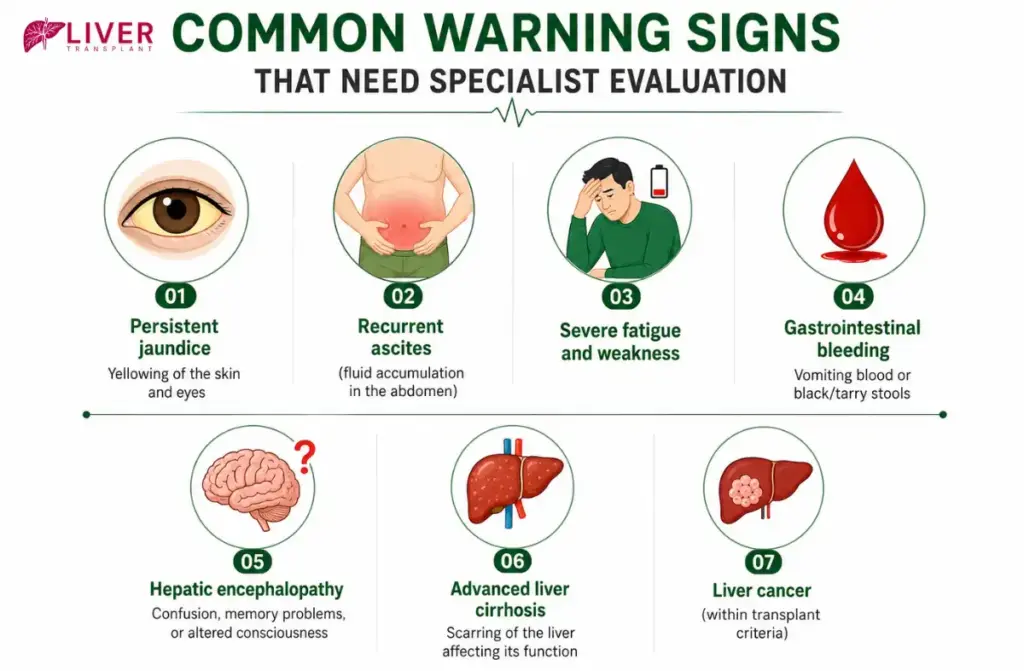
Doctors may also use tools such as the MELD score to assess the severity of advanced liver disease and help determine transplant priority. It is important, however, not to view the score in isolation. The patient’s overall condition, complications and expected benefit from transplantation all contribute to the decision.
The journey is usually gradual
| Stage | What is happening |
| Chronic liver disease | The underlying condition is treated and liver function is monitored |
| Advanced liver disease | Liver function declines and complications may become more frequent |
| Transplant evaluation | A specialist team assesses whether transplantation may be beneficial |
| Transplant planning | Deceased donor and living donor options are considered |
| Transplant surgery | The diseased liver is replaced when transplantation proceeds |
| Long-term care | Medication, monitoring and lifestyle measures continue |
A transplant evaluation is therefore a step toward understanding the patient’s options, not automatically a decision to operate.
Which Conditions Can Lead to Liver Transplantation?
The diagnosis alone does not determine whether someone needs a transplant. What matters is the extent of liver damage, the complications that have developed and whether the liver can continue to support the body safely.
Conditions that may eventually lead to transplant evaluation include:
- Cirrhosis: Advanced scarring can develop from chronic hepatitis, alcohol-related liver disease, fatty liver disease, autoimmune conditions and several other causes.
- Chronic hepatitis B or C: Long-standing viral hepatitis can progressively damage the liver and, in some patients, lead to cirrhosis and liver failure.
- Advanced fatty liver disease: Metabolic liver disease can progress from fat accumulation to inflammation, scarring and eventually severe liver dysfunction.
- Acute liver failure: A sudden loss of liver function can occur because of certain medications or toxins, infections, autoimmune disease and other causes.
- Liver cancer: Some patients with liver cancer may be considered for transplantation when the tumour and overall disease meet appropriate criteria.
- Genetic and metabolic disorders: Conditions such as Wilson’s disease can cause severe liver damage and, in advanced cases, may require transplantation.
- Paediatric liver disease: Biliary atresia and other serious childhood liver disorders are important causes of paediatric transplantation.
Having one of these conditions does not automatically mean a transplant is required. The timing and need for transplantation are determined individually.
What Happens During a Liver Transplant Evaluation?
Once transplantation becomes a possibility, the patient undergoes a detailed assessment.
This can seem like a long process, especially when someone is already unwell. But every part has a purpose. The transplant team needs to understand not only the condition of the liver, but also whether the heart, lungs, kidneys and other systems can safely tolerate a major operation.
The evaluation commonly includes:
- Blood and laboratory tests: These assess liver and kidney function, blood group, clotting ability, nutritional status and possible infections.
- Imaging: Ultrasound, CT or MRI may be used to examine the liver, blood vessels and surrounding structures and to look for tumours or other findings that could affect treatment.
- Heart and lung assessment: These tests help determine whether the patient can safely tolerate major surgery and the changes that occur during recovery.
- Nutritional assessment: Advanced liver disease can lead to weight loss and muscle loss. Improving nutritional health before surgery can make recovery more manageable.
- Infection screening: Existing infections may need to be identified and treated because medicines used after transplantation suppress the immune system.
- Psychological and social assessment: Successful transplantation requires regular medication, follow-up and practical support at home. These factors are therefore part of responsible transplant planning.
Why is so much assessment necessary?
The evaluation is not simply a test of whether someone is “fit for surgery.”
It is an opportunity to identify problems before surgery rather than discovering them during recovery.
For example, a nutritional deficiency can be addressed, an infection can be treated or a heart-related concern can be investigated before transplantation. In some patients, the evaluation may also show that continued medical treatment is more appropriate at that stage.
Living Donor or Deceased Donor: What Is the Difference?
The potential donor must undergo detailed assessment to establish:
- Medical fitness: The donor must be healthy enough to undergo major surgery.
- Suitable liver anatomy: The size and structure of the liver and its blood vessels must be appropriate for donation.
- Compatibility: Blood group and other clinical factors are considered when assessing suitability.
- Informed and voluntary decision-making: The donor must understand the risks, recovery and long-term implications without pressure from others.
| Deceased Donor | Living Donor |
| Liver comes from a deceased organ donor | A healthy person donates a portion of their liver |
| Timing depends on organ availability | Surgery can be planned when evaluation is complete |
| No living donor undergoes surgery | Both donor and recipient undergo major surgery |
| Waiting time may vary | Requires a medically suitable donor |
Living donation is not a risk-free alternative to waiting. The safety of the donor remains an essential part of every responsible transplant programme.
Preparing for Liver Transplant Surgery
Once transplantation is considered appropriate, preparation begins.
The team may need to control complications of liver disease, treat infections, improve nutritional status and review existing medications. The aim is to make the patient’s condition as stable as possible before a major operation.
If a living donor is involved, the donor undergoes a separate evaluation before surgery is approved.
For a deceased donor transplant, the timing can be less predictable because a suitable organ must become available.
Throughout this period, the focus remains the same: prepare carefully, identify risks early and make sure the patient is ready when transplantation becomes possible.
What Happens During Liver Transplant Surgery?
Liver transplantation is a major operation and can take several hours, depending on the patient’s condition and the complexity of the procedure.
The diseased liver is removed and replaced with the donor liver or, in a living donor transplant, the appropriate portion of the donor liver. The surgical team carefully connects the new liver to the recipient’s blood vessels and bile duct.
After surgery, the patient is usually monitored closely in an intensive care setting.
The early period is particularly important because the team needs to watch for complications such as:
- Bleeding or blood clots
- Problems with blood flow to the transplanted liver
- Infection
- Bile duct complications
- Early problems with liver function
- Rejection or other immune-related complications
Once the patient’s condition becomes stable, attention gradually shifts toward recovery. Movement is increased, nutrition is supported and medicines are adjusted according to the patient’s response.
The hospital stay varies from one person to another. Recovery depends on the patient’s health before surgery, the complexity of the transplant and whether complications occur.
What is Recovery Like After a Liver Transplant?
Leaving the hospital is an important milestone, but it is not the end of treatment.
The first few weeks usually involve frequent blood tests and follow-up visits. The transplant team closely monitors liver function and adjusts medications as the body settles into its new routine.
Patients may also experience fatigue, weakness or changes in appetite during the early recovery period. These symptoms can improve gradually as strength returns.
A general pattern may look like this:
| Recovery period | What may generally happen |
| First few weeks | Frequent monitoring, medication adjustments and gradual physical recovery |
| First 1–3 months | Strength begins to improve and light daily activities may gradually resume |
| Following months | Follow-up often becomes less frequent as recovery stabilises |
| Long term | Lifelong medication, monitoring and healthy lifestyle habits remain important |
This is only a general guide. There is no single recovery timetable for every transplant recipient.
A person who was very unwell before surgery may need considerably more time to regain strength, while another patient may progress more quickly.
How Should Patients Approach the Decision?
A liver transplant is a major decision, but it does not have to be understood all at once.
The most useful discussions usually centre on a few fundamental issues:
- Why is transplantation being considered now? Understanding what has changed in the liver disease can make the recommendation easier to understand.
- Are other treatments still appropriate? Not every patient who enters a transplant programme requires immediate surgery.
- What donor options are available? A living donor may be possible for some patients, while others may need to rely on deceased donor transplantation.
- What would recovery involve? Understanding medication, follow-up and lifestyle changes helps families prepare for life after surgery rather than focusing only on the operation itself.
- What are the individual risks? General information is useful, but the patient’s own medical condition determines much of the actual risk.
A second opinion can also be reasonable when the decision is complex or when the patient and family want additional clarity. It can help confirm the diagnosis, review the treatment pathway and ensure that important questions have been addressed.
Choosing a Transplant Centre
Because transplantation extends far beyond the operating room, the experience and organisation of the transplant programme matter.
A strong transplant service should have access to the specialists and infrastructure needed throughout the patient’s journey, including:
- Experienced transplant surgeons and hepatologists
- A coordinated multidisciplinary team
- Appropriate intensive care facilities
- Access to transplant-related investigations and interventions
- Nutritional and psychological support
- Structured follow-up after discharge
- Clear communication about risks, recovery and long-term care
The quality of care is not measured only by what happens inside the operating theatre. Transplantation is a long-term relationship between the patient and the medical team.
Conclusion
A liver transplant can be one of the most significant turning points in the life of a patient with advanced liver disease. It is a major operation, but it is also a carefully planned journey that begins well before surgery.
The process moves through several stages: understanding the severity of liver disease, evaluating whether transplantation is appropriate, considering donor options, preparing for surgery and then protecting the new liver through lifelong follow-up.
For many patients, transplantation can offer a meaningful improvement in survival and quality of life when the liver can no longer support the body’s needs.
What initially feels like an overwhelming decision becomes easier to approach when each stage is understood clearly. The right treatment pathway ultimately depends on the individual’s condition, and that decision should be made with a qualified hepatology and transplant team after a thorough evaluation.
Read More: Liver Transplant Cost